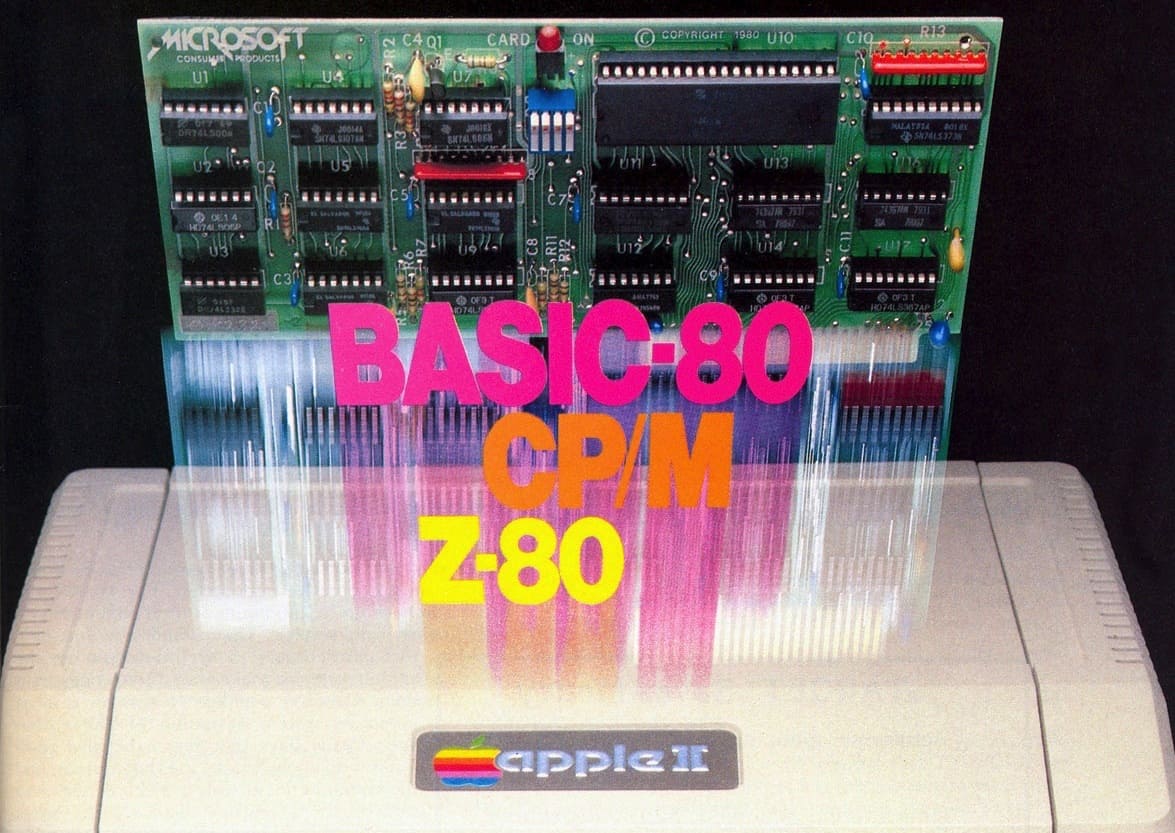
 April 2, 1980: Microsoft releases its first hardware product, the Z-80 SoftCard. A microprocessor card that plugs into the Apple II, it allows the computer to run programs designed for the CP/M, a popular operating system for business software.
Arriving several years before the first version of Windows, the Z-80 SoftCard quickly becomes a big hit for Microsoft.
Microsoft’s Z-80 SoftCard makes Apple II a business computer
In the early years of the personal computing revolution, hardware mattered — but software ecosystems mattered more. And they were still fragmented, incompatible islands. The Apple II computer, released in 1977, was one of the first breakout hits of the microcomputer era. But on its own, it couldn’t run CP/M, which was becoming an industry standard platform for serious business applications.
The arrival of Microsoft’s Z-80 SoftCard in 1980 effectively bridged that divide, turning the Apple II into a dual-personality machine that could tap into a vast library of professional software previously out of reach.
The Z-80 SoftCard reflected a key dynamic of the era: The race wasn’t just to build better computers, but to make them compatible, useful and indispensable. And sometimes, the fastest way forward was to plug one revolution directly into another.
A hardware key that unlocked the most popular business software of the day
A straightforward plug-and-play peripheral for the Apple II, the Z-80 SoftCard contained a Zilog Z80 CPU and the necessary “decoding circuitry” to read the signals on the Apple computer’s bus.
It allowed the Apple II to run loads of business software that required a Z80 CPU, most notably popular word processor WordStar and relational database management software dBase.
At the time of its introduction, InfoWorld magazine referred to the Z-80 SoftCard as a “fascinating piece of hardware.”
“If you need a lightweight, portable Z-80 computer, the Apple/SoftCard combination is a perfect pair,” the publication concluded.
Apple II accessory becomes a hit
The $349 card (the equivalent of more than $1,470 today) was, in some ways, a surprise hit for Microsoft. Coming packaged with Microsoft BASIC, it debuted at the West Coast Computer Faire in March 1980 and went on sale the following month. In its first three months, Microsoft sold 5,000 units — considered a big success at the time.
In fact, the Z-80 SoftCard quickly became Microsoft’s No. 1 revenue source. And it remained the company’s most successful hardware product until Microsoft introduced a mouse in 1983.
Microsoft continued its involvement with Apple for the next few years — albeit increasingly in software. By the mid-1980s, Microsoft became one of Apple’s most valuable developers. So much so that Apple CEO John Sculley signed a damaging contract to keep Bill Gates and Co. hanging around.
First came the Z-80 SoftCard, then Windows …
By the end of the 1980s, Microsoft had achieved great success with Windows, which it launched in 1983. The PC operating system proved so popular that Microsoft challenged Apple in the marketplace.
Over the next 20 years, Microsoft’s software-based business model dominated the tech industry, eclipsing Apple’s own-everything-we-make approach.
In recent years, Microsoft accelerated its hardware push with its Surface lineup, producing tabletop computers, laptops, hybrid tablets, dual-screen Android devices and even touchscreen whiteboards. The company’s recent focus on artificial intelligence once again vaulted it toward the top of the market capitalization heap.
But Microsoft’s hardware ambitions started with the Z-80 SoftCard, the clever peripheral that allowed the Apple II to run the most popular software of the time.

Luke Dormehl is a U.K.-based journalist and author, with a background working in documentary film for Channel 4 and the BBC. He is the author of The Apple Revolution and The Formula: How Algorithms Solve All Our Problems … and Create More, both published by Penguin/Random House. His tech writing has also appeared in Wired, Fast Company, Techmeme and other publications.

